
For years, the green building conversation centred on energy efficiency. But the climate crisis demands a new focus: full-spectrum carbon accountability.
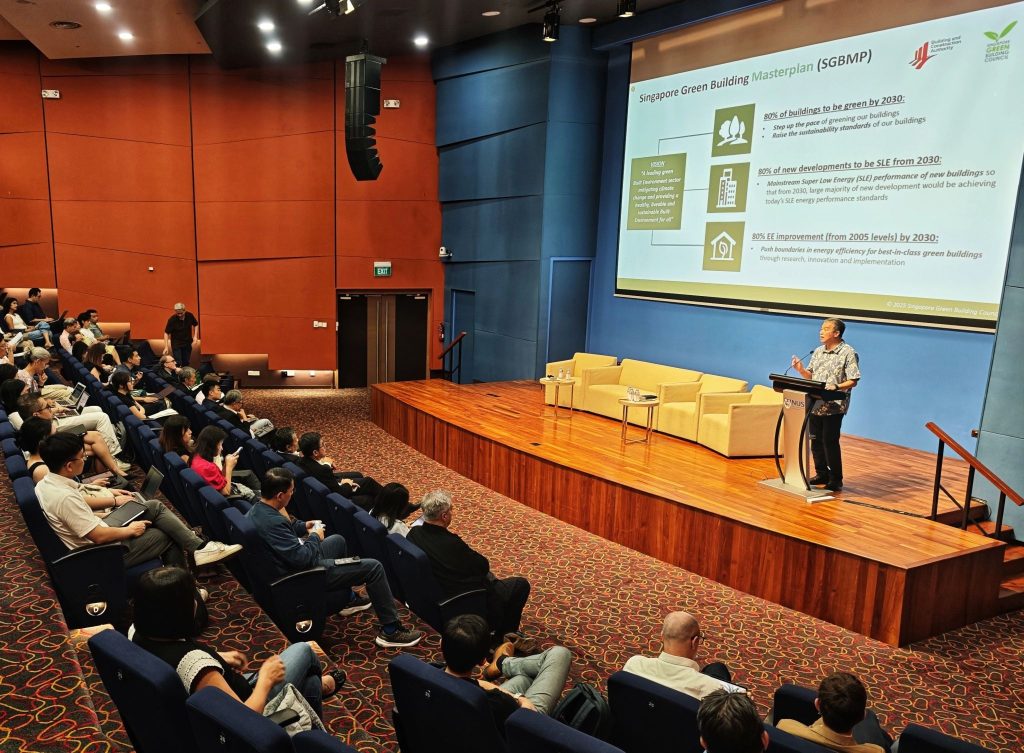
As SGBC President Mr. Allen Ang highlighted at the Rethink Carbon event organised by the Institute of Real Estate and Urban Studies (IREUS) on 31 October 2025, embodied carbon – the emissions from manufacturing, transporting, and constructing our buildings – can make up over half of a building’s lifetime carbon footprint. In a dynamic city like Singapore, this is the next critical frontier in our climate aspirations.
So, how is SGBC driving this transition from awareness to action?
🔢 Building the Foundation for Measurement
You cannot manage what you cannot measure. That is why we have worked with key industry stakeholders to develop and maintain free, locally-calibrated tools like the Building Embodied Carbon Calculator (BECC) and the Mechanical & Electrical Carbon Calculator (MECC). These digital tools empower project teams to quantify and reduce carbon from the earliest design stages. As one professional noted after experiencing the calculator during Singapore Design Week 2025: “I did not realise how much emissions I work with every day until I went to calculate.” This is the power of making the invisible, visible.
🏗️ Creating Market Pull for Low-Carbon Building Products
Measurement alone is not enough. We are evolving the Singapore Green Building Product (SGBP) certification, transitioning key material categories such as steel and concrete to require manufacturer-specific Environmental Product Declarations (EPDs). This ensures precise, traceable data and builds a robust pipeline of certified low-carbon building products for the built environment sector.
These efforts, alongside national movements like Go 25, show that achieving a net-zero future is a team effort. The blueprint is clear. The tools are here. Now, let’s build a future that is not just sustainable, but regenerative and carbon-neutral.
Explore our free carbon calculators and learn more about our other carbon resources here.