
Singapore’s Go 25 movement encourages indoor air-conditioning setpoints of aorund 25°C to reduce energy consumption and advance net-zero targets. Yet in a tropical climate, temperature alone cannot deliver comfort, health, or energy efficiency if the air remains humid. Humidity control, specifically maintaining a lower dew point and approximately 50% relative humidity (RH). This is the missing piece that will further advance the Go 25 movement.
Why Humidity Control Matters in Tropical Climates
Typical outdoor conditions in Singapore average around 32°C and 70% RH, equivalent to approximately 21 g/kg of moisture. Traditional HVAC systems are optimised to reduce dry-bulb temperature, but they often struggle with latent heat, which is the energy required to remove moisture. In humid climates, this latent component can dominate comfort and indoor air quality outcomes.

According to Figure 1, latent cooling accounts for over 70% of total cooling demand in tropical regions like Singapore. When this latent load is addressed by dedicated dehumidifier, the mechanical chiller focuses solely on sensible cooling. Pre-drying the supply air allows the chiller to operate at a higher dew point, which enhances efficiency. This reinforces why dehumidification is essential for air-conditioning systems. It not only reduces mould risk but optimises energy use and sustainability.
Raising Setpoint Alone Does Not Address Mould Risk
The argument that “25°C eliminates condensation, so mould won’t appear” oversimplifies what happens in buildings:
- At 21°C with high RH, cold surfaces (such as diffusers, windows, ducts) can hit the dew point, causing condensation and localised mould risk.
- At 25°C with the same high RH, you may reduce some condensation risk on occupied surfaces, however:
– RH in the space can remain uncomfortably high.
– Micro-climates in ducts, ceiling voids, cold bridges, and behind furniture can still reach critical RH for mould.
– Materials can absorb and retain moisture, creating a hidden mould reservoir.
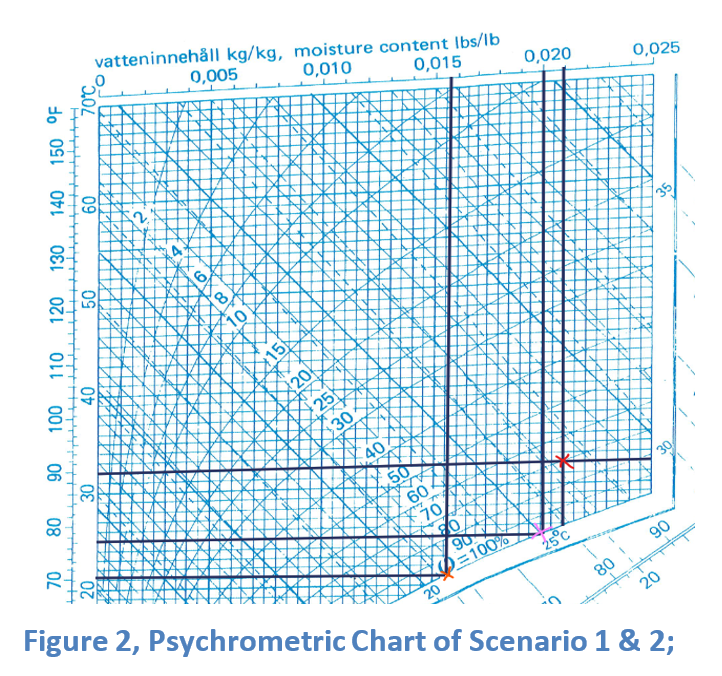
Consider two operating scenarios:
- At a 21°C setpoint, the cooling coil can remove roughly 5.4 g/kg, leaving indoor air at 15.6 g/kg.
- At 25°C, the coil may remove only about 1.0 g/kg, leaving indoor air at approximately 20 g/kg.
In simple terms, raising the temperature without drying the air leaves much of the moisture behind.
Without dedicated humidity control, the air retains significantly more moisture, pushing dew points upwards and sustaining conditions where mould can thrive, especially in corners, behind furniture, and other low-ventilation areas. Increasing ventilation without dehumidification compounds the problem by introducing more humid outdoor air.
In other words: Raising temperatures without controlling humidity is like turning down the volume on one speaker while the other is still blasting. You have not solved the problem; you just moved it.
Mould thrives on moisture, not just cold surfaces. Even at 25°C, high RH in ducts, ceiling voids, and building materials can create hidden mould reservoirs.
Why 50% RH Is a Game-Changer
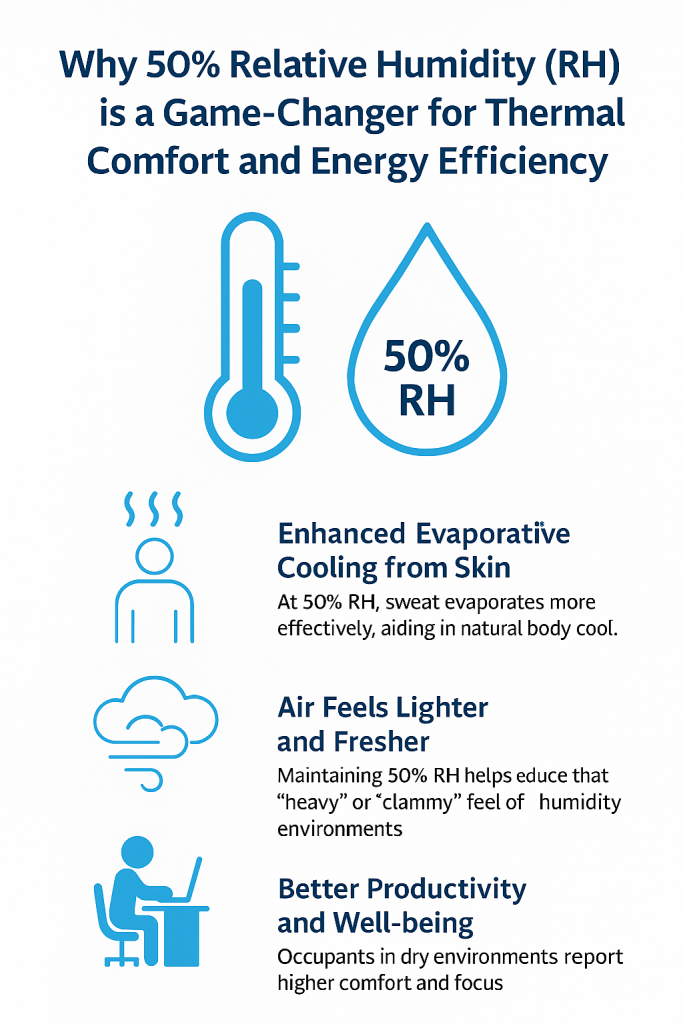
At approximately 50% RH:
- Evaporative cooling from skin becomes more effective, so people feel comfortable at higher temperature setpoints.
- Air feels lighter and fresher, avoiding that sticky sensation common in humid offices.
- RH is low enough to significantly reduce mould and dust mite activity, supporting healthier indoor environments.
Successful Go 25 implementation is not just: 25°C + More Ventilation; it should be: It should be: 25°C + 50% RH + Properly Treated Ventilation Air
Munters HCU: Decoupling Moisture Removal from Cooling
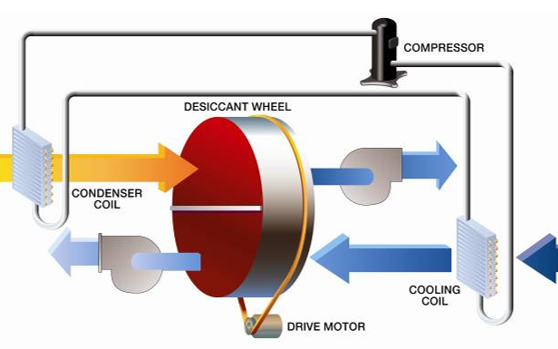
The Munters HCU employs a desiccant rotor reactivated using recycled waste heat from cooling components. Specifically, the system captures heat from the condensing coil of the refrigeration system—heat that would normally be rejected to the environment—and repurposes it to reactivate the desiccant wheel. This process ensures the rotor maintains its moisture-absorbing capacity without requiring additional electric or gas heaters.
Why does this matter?
- Energy efficiency: By using waste heat instead of new energy input, the system significantly reduces operating costs.
- Sustainability: Repurposing heat lowers overall energy consumption and carbon footprint.
- Continuous performance: The rotor can consistently remove moisture without adding extra thermal load to the cooling system.
The Munters DryCool HCU enables exactly that:
- 25°C setpoint to save energy
- 50% RH to keep spaces light, fresh, and mould-resistant
- Properly conditioned outdoor air that meets SS554 without importing humidity problems
- Waste-heat-driven “free drying”, aligning with Singapore‘s sustainability goals.
By treating 100% makeup air when humidity exceeds a setpoint, the HCU delivers neutral temperature air at a low dew point, reducing the latent load on downstream AHUs. AHUs can then focus on sensible cooling, improving system efficiency and comfort at 25°C.
When the HCU handles the latent (moisture) load:
- FCUs and chilled water systems only need to manage sensible cooling (temperature).
- Coils run more efficiently, with less risk of coil wetting and biofilm growth.
- Equipment cycles less aggressively, improving system longevity and reliability.
- Surface condensation risk is significantly reduced because the bulk room air is drier.
Applications Across the Built Environment
Commercial offices, retail malls, hospitality, healthcare facilities, and data centres all benefit from dedicated humidity control. In data centres, controlling moisture helps prevent corrosion, static discharge variability, and equipment failure risks. In occupied spaces, humidity management enhances comfort, reduces odour and dampness, and supports infection control strategies by stabilising indoor air quality.
By delivering dry air at 25°C and controlling RH, the HCU aligns with the aims of the Go 25 movement. Integrating humidity metrics into design and operations strengthens Green Mark submissions by demonstrating tangible improvements in indoor environmental quality and energy performance
GoDry to Go 25
Raising the thermostat is a good first step-but it is not the whole solution. To truly protect against mould and ensure comfort, Singapore’s offices must integrate temperature control, humidity control, and ventilation design. With Munters DryCool HCU, building owners do not have to choose between:
- Comfort vs Energy Savings
- Ventilation vs Humidity
- 25°C vs Mould Risk
Instead, they can deliver cool, dry, healthy workplaces that fully support the Go 25 movement Less Energy, Less Moisture, More Comfort.
Article contributed by Munters Pte Ltd