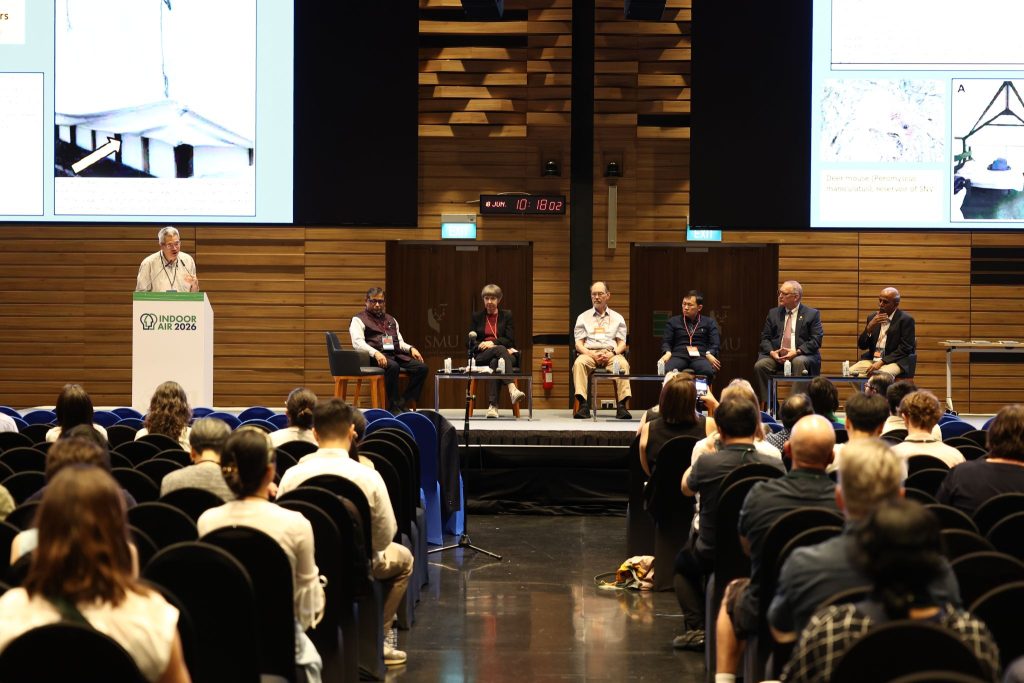
On 18 June 2026, something rare and powerful took place at Indoor Air 2026 – a genuine bridge between two worlds that don’t always talk to each other.
The late-breaker session, “A Medical-Engineering Game Plan for Airborne Outbreaks,” brought together medical practitioners and engineers to tackle a question that affects us all: How do we prevent airborne outbreaks in the spaces where we live, work, and travel?
Co-convened by Dr. Julian Tang, a medical expert specialising in airborne transmission and clinical virology, and Prof. Chandra Sekhar, an engineering expert in building ventilation and IAQ, the session was a masterclass in interdisciplinary collaboration.
The session also brought together a distinguished panel of Singaporean and international experts – a true testament to the global nature of this challenge and the power of cross-border collaboration:
- Distinguished Professor Lidia Morawska – WHO advisor
- Prof. Don Milton – airborne transmission expert
- Prof. Paul Tambyah – infectious disease specialist
- Dr. Chang Wei KANG – CFD specialist
- Prof. William Bahnfleth – ASHRAE Distinguished Lecturer
Using a recent cruise-ship Hantavirus incident as a case study, the session explored:
- Practical engineering controls – ventilation optimisation, outdoor-air strategies, airflow management
- Policy and cost-effectiveness arguments for implementation
- How to conduct rigorous engineer-led outbreak investigation research in collaboration with the medical fraternity
- Candidate study designs – tracer-gas and smoke visualisation, manikin-based experiments, CFD modelling
The key takeaway? We cannot wait for the next outbreak to figure this out. Preparedness, collaboration, and evidence-based engineering interventions are our best defence.
One of the most important outcomes of this session was the call to close a longstanding gap: how to conduct rigorous, engineer-led outbreak investigation research in partnership with the medical community. Because when the next airborne threat emerges, we need more than masks and hand sanitiser. We need buildings designed to protect us – and the data to prove what works.