

Electricity bills for Singapore Small & Medium Enterprises (SMEs) have risen sharply in recent months. Spot tariffs that sat comfortably around $0.25 per kWh not long ago have drifted past $0.30 in the current supply environment, and businesses are now facing a very different market. For a small contractor, a fabrication workshop, or a family-run finishes supplier, that is not a line item. It is the difference between a viable month and a tight one.
The Energy Efficiency Grant is genuinely useful in that context. Administered under Enterprise Singapore’s SME support framework, the Grant co-funds up to 70 percent of the cost of pre-approved energy-efficient equipment, from LED lighting, efficient air-conditioning and chillers, to high-efficiency motors, which is capped at S$30,000 per qualifying SME for pre-approved EE Equipment. For construction and manufacturing firms in particular, the menu is practical, the administration is sensible, and take-up has accelerated through the past two quarters.
For SME business leaders in the built environment sector, however, the electricity bill is the shallow end of the pool. A bigger current is already moving through the supply chain, and it does not stop when the power tariff does.
That current is environmental disclosure. Three years ago, a building contractor, cement supplier, woodwork shop, or paint manufacturer could win work on price, relationships, and delivery reliability. Today, tender requirements incorporate sustainability criteria, increasingly asking for a product-level carbon footprint report, a greenhouse-gas emissions inventory for the supplier, and a sustainability report that ties both together.
Developers pursuing the Building and Construction Authority (BCA) Green Mark Platinum or Super Low Energy certification will prioritise Main Contractors who use more sustainable materials, including those certified under schemes like the Singapore Green Building Product (SGBP) certification scheme. Increasingly, the SGBP certification for materials such as ready-mix concrete and steel requires manufacturers to obtain Environmental Product Declarations (EPDs). Developers with green loans also have covenants that require them to meet certain sustainability requirements.
A company without this climate disclosure data does not usually get an objection at the tender meeting. It gets a quiet drop from the specification sheet. The contract goes to the competitor who has an EPD on file, whose emissions inventory is current, and whose sustainability report meets the GRI or IFRS disclosure expectations the buyer’s procurement team was handed this year.
The commercial stakes are not abstract. Embodied carbon can account for up to 50 percent of a Singapore commercial building’s whole-life emissions, with concrete, steel, and glass the dominant line items. A contractor chasing BCA Green Mark Platinum or Super Low Energy certification has a finite carbon budget to spend across its materials schedule, and will spend it with suppliers whose product data is verifiable. For the supplier, that is the difference between a recurring slot on approved-vendor lists and a gradual exclusion from the projects that are actually growing.
This is why the grant conversation and the disclosure conversation belong together. An SME that uses the Energy Efficiency Grant to upgrade its HVAC system or swap in efficient motors gets a real reduction on its electricity bill. On top of that, via carbon accounting and disclosure, the SME can prove that reduction in a procurement conversation, and credibly narrate the corresponding Scope 1 or Scope 2 improvements in its sustainability report. The investment happens. The commercial gains of winning deals make the return on investment complete.
The practical sequence for a built-environment SME is not complicated, and does not need to be expensive. First, run a Scope 1 and Scope 2 inventory, like fuel, electricity, refrigerants, and set a clean baseline year. Second, apply for the Energy Efficiency Grant for the equipment upgrades that already make economic sense on their own terms, and measure the post-implementation impact against that baseline. Third, for product-selling SMEs, commission a Life Cycle Assessment on the one or two product lines most likely to end up in Green Mark-specified projects, and publish the EPD before pursuing SGBP certification. Fourth, package the baseline, the reductions, and the product data into a sustainability report a buyer’s procurement team can read in under ten minutes.
This used to be a consulting-heavy process that priced smaller firms out. It no longer has to be. Platforms now exist that automate the carbon accounting step, integrate Life Cycle Assessment (LCA) data from verified material databases, and produce EPD-ready outputs without a separate six-figure engagement. The point is not which platform. The point is that a construction firm in 2026 can reach disclosure-readiness at a cost that makes commercial sense against the tenders it is actually competing for.
Rising electricity bills are apparent. The disclosure pressure is growing with rising mandatory sustainability criteria in public and private tenders. The grant is the reason to act on energy now. The disclosure trajectory on improving operational efficiencies and winning more business is the reason not to stop there.
For built-environment SMEs, the real competitive advantage lies not in the price of a kilowatt-hour, but in the ability to back sustainability progress with credible data, demonstrating total energy savings and emissions reduction through active decarbonisation and related initiatives. The firms with strong sustainability capabilities will find themselves on the preferred-supplier shortlist of green-tendered projects in Singapore. The firms that do not, will find that the electricity bill is the least of their problems.
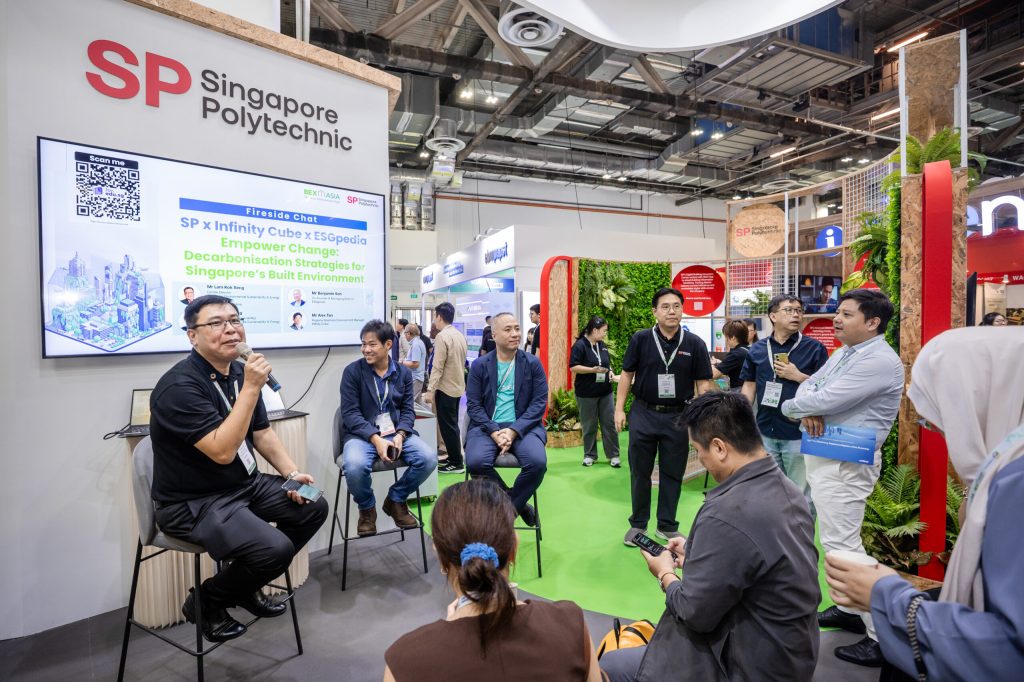
Article contributed by:
Benjamin Soh
Founder, ESGpedia