
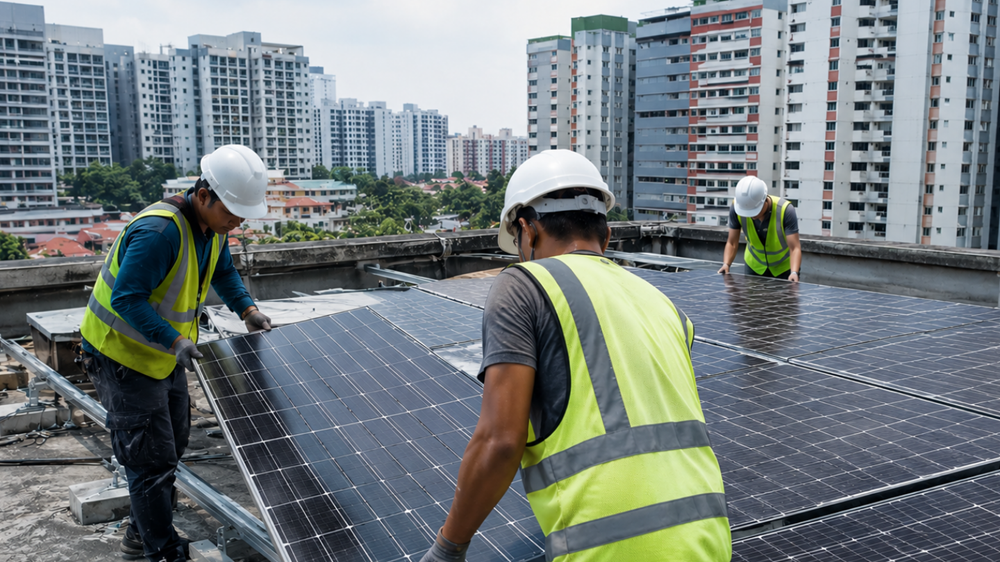
Singapore’s solar fleet has grown rapidly over the past decade, with nationwide installed solar capacity surpassing 2 GWp in 2025 through deployment across public housing, industrial facilities, commercial buildings, and other infrastructure. Government-led initiatives such as the HDB SolarNova have played an important role in accelerating adoption at scale. As these installations mature over the coming years, Singapore will increasingly face the challenge of managing ageing solar assets in a sector still oriented almost entirely around installation rather than stewardship.
For most of the past decade, the conversation centred on capacity: how many panels, how fast, at what cost. That served a purpose, but it produced a blind spot. Panels installed five to ten years ago are being treated as passive infrastructure, monitored occasionally and left to degrade until failure or a lease renewal forces a decision. The question the built environment sector now needs to ask is not how much solar it has installed, but how well it is managing what it has built.
Solar panels degrade, and the losses compound
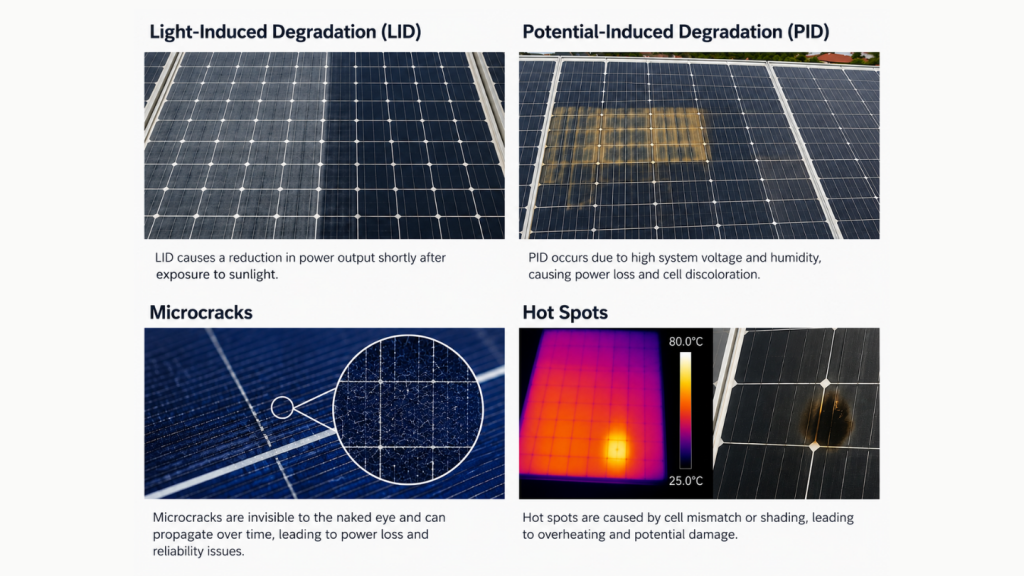
Solar panels naturally experience performance degradation over time due to a combination of environmental, operational, and material factors. These can include Light-Induced Degradation (LID), Potential-Induced Degradation (PID), microcracks, hot spots, moisture ingress, soiling, shading, inverter-related issues, string mismatch, and other age-related defects that affect long-term system performance.
This matters commercially. The payback period and avoided energy cost calculations for a solar installation are modelled against projected output. If actual output runs meaningfully below those projections, the asset is underperforming its business case. In a land-scarce environment where rooftop space is genuinely constrained, underperforming panels also represent a direct opportunity cost: that area is not being used at its best available yield.
Singapore’s hot, humid, and high-irradiance environment can further increase field stresses on solar systems over time, making ongoing monitoring and lifecycle management increasingly important as installations age.
Retain, Repair, or Repower: a decision driven by evidence
Lifecycle stewardship begins with physical assessment, not just a review of monitoring data. Output figures can tell you something has changed; they cannot tell you why, which panels are responsible, or whether the issue can be resolved through maintenance, repair, or replacement. Services such as electroluminescence imaging, thermal inspection, and on-site measurement are available within the market to support more informed technical assessments of solar asset condition. That assessment generally leads to one of three outcomes:
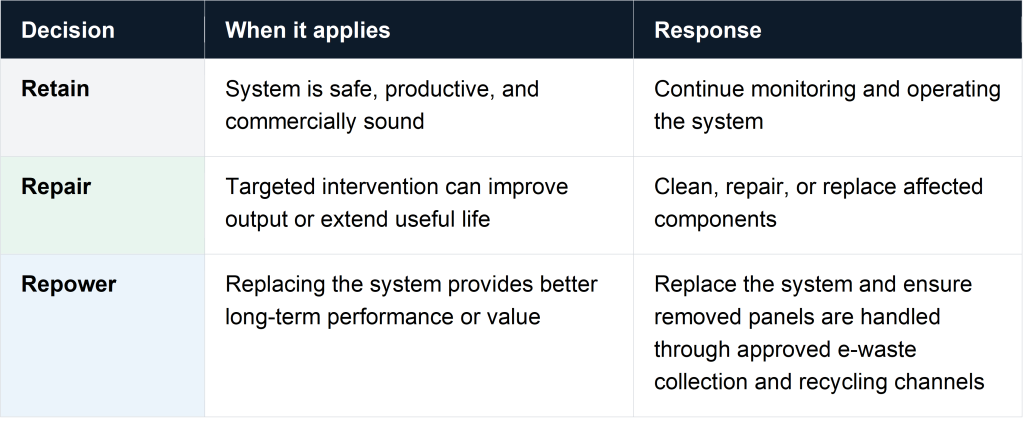
The discipline here is resisting the pull toward either extreme. Replacing panels before the economics justify it generates unnecessary waste and destroys capital value. Retaining panels that are genuinely degraded or unsafe also destroys value and introduces risk. The right answer follows from evidence, not assumption.
End-of-life is a compliance matter
Singapore’s Resource Sustainability Act places solar PV panels within the regulated e-waste framework. Panels removed from service, whether at end of life or during a repower, should be handled through approved or licensed e-waste collection and recycling channels, with proper documentation retained. Many asset owners have not yet absorbed what this means in practice: a project removing several hundred panels generates significant regulated e-waste, and the plan for handling it must be part of the project scope from the outset, not resolved on the day of removal.
A key principle: Do not create unnecessary waste in the name of sustainability. True circularity requires that the decision to remove panels is justified by evidence, and that when removal occurs, materials are recovered through certified channels rather than discarded.
There is also a materials value argument. Decommissioned panels contain commercially recoverable commodities including glass, silicon, aluminium, and copper wiring. Modern recycling processes can recover a substantial proportion of these materials, helping reduce landfill burden and supporting broader resource circularity objectives.
The next chapter of solar in the built environment
The tools, the regulatory framework, and the commercial logic for responsible solar lifecycle management now exist. What is needed is a shift in how asset owners think about the panels on their rooftops: not as passive infrastructure, but as managed assets with a value curve, a compliance obligation, and recoverable material at the end of their life.
The practical questions are straightforward. When was the system last physically assessed? Has output drift been investigated or simply accepted? Is there a decommissioning plan that satisfies Singapore’s e-waste requirements? Has the repower case been formally modelled against the alternatives? These are not difficult questions to answer, but they do require the right expertise to ask.
Circularity is not an end-of-life decision you make 20 years from now. It is a strategy you design into how you manage your solar infrastructure from today. Singapore is well positioned to lead on this. The scale of deployment, the regulatory clarity, and the growing availability of assessment tools, lifecycle management practices, and responsible end-of-life solutions together make the case for lifecycle stewardship compelling, not as an aspiration, but as standard practice.
Article contributed by:
Vector Green is a Singapore-based energy and sustainability engineering advisory firm helping organisations plan and implement practical energy transition solutions. It supports businesses in reducing emissions across Scope 1, 2, and 3, improving energy efficiency, and deploying renewable energy infrastructure.
To learn more about how Vector Green supports businesses in solar lifecycle management, energy efficiency, and renewable energy infrastructure planning, please visit https://vectorgreen.com.sg