Traditional Building Management Systems (BMS) have long been the reliable backbone of our real estate infrastructure. They were engineered to keep the lights on, the air flowing, and the machinery running safely.
But as we look toward the near future, with mandatory carbon disclosures hitting major APAC markets, the demands on our built environment are fundamentally changing. With rising energy tariffs and a tightening facilities management talent pool, building operators are being asked to achieve unprecedented levels of efficiency. Meeting these modern ESG and financial benchmarks requires giving our existing infrastructure a new brain: moving from manual oversight to autonomous, AI-driven optimisation.
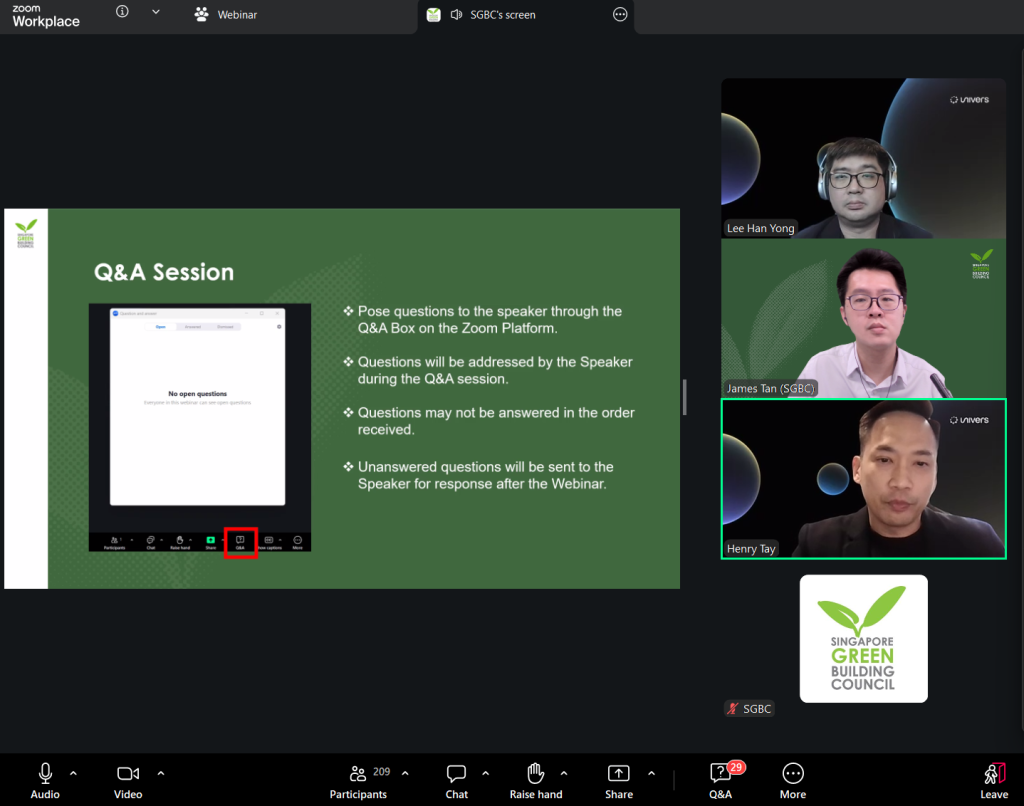
At the SGBC Webinar this afternoon, the team at SGBC Member Univers shared how we can build upon existing BMS foundations to transition into the next era of estate management:
- From Localised to Portfolio-Wide: Transitioning from site-by-site isolation to unified coordination across your entire building estate.
- From Static to Adaptive: Moving past rigid, scheduled automation to closed-loop, AI-driven HVAC optimisation that responds to real-time variables.
- From Reactive to Exception-Based: Empowering busy engineering teams to AI monitors routines at scale, freeing humans to focus purely on high-value exceptions.
- From Cost Center to Performance Asset: Turning telemetry data into financial strategy to tracing an asset anomaly directly to its impact on carbon intensity and operational KPIs.
The next tier of portfolio value won’t require ripping out your legacy investments. It’s about sitting an intelligent, cross-protocol AI layer right on top of them to turn raw data into auditable, net-zero outcomes.