Cooling is Singapore’s quiet energy problem. It accounts for the bulk of a typical building’s energy consumption and carbon emissions, and demand is still climbing as temperatures rise, haze returns annually, and expectations of indoor comfort grow. Any credible path to greener buildings in the tropics has to start with how we cool them.
The obstacle is equally clear: nobody adopts sustainable cooling if it makes them feel worse. Solutions that ask occupants to simply tolerate higher temperatures rarely survive contact with real life.
Comfort is a “feels like” problem, not a thermostat problem
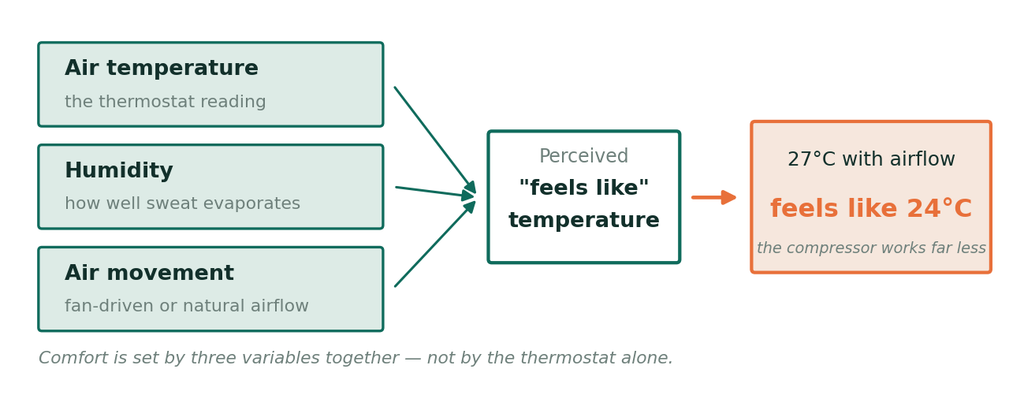
Anyone who has checked a weather app overseas knows the gap between air temperature and perceived temperature. A -1°C day can feel like -10°C in strong wind. The same physics works in our favour in the tropics: temperature, humidity and air movement together determine how warm a space actually feels.
This is the principle behind mixed-mode ventilation (MMV): use natural ventilation and fan-driven airflow as the first line of cooling, and run air-conditioning at a higher setpoint only when needed. If airflow can make 27°C feel like 24°C, the compressor works dramatically less for the same comfort.
The evidence: significant savings without sacrificing comfort
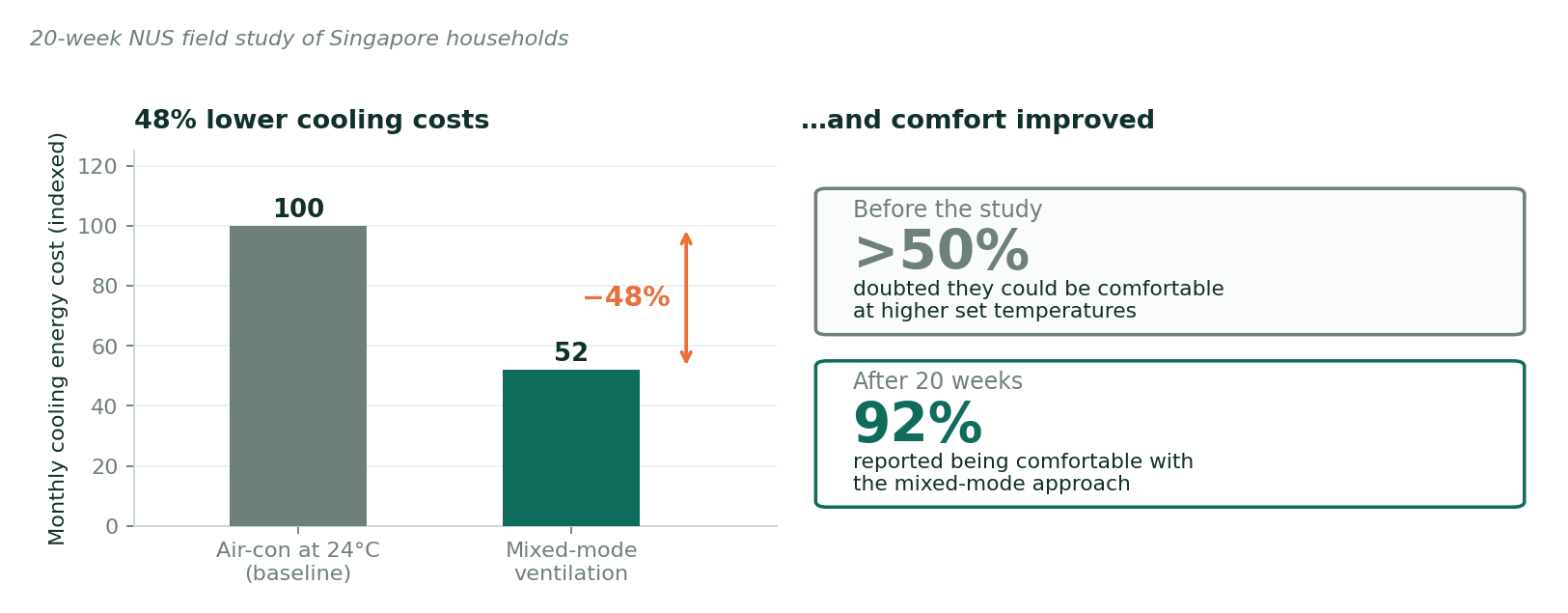
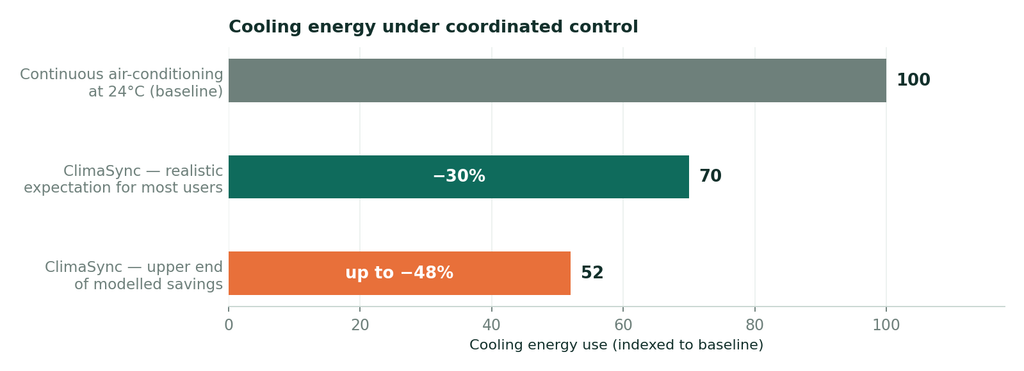
The savings are not theoretical. A 20-week field study by NUS researchers tracked Singapore households adopting MMV, pairing natural ventilation and ceiling fans with air-conditioning used only as needed. Participants achieved a 48% reduction in monthly cooling energy costs compared with running air-conditioning at 24°C.
Just as important was the comfort finding. More than half of participants initially doubted they could live comfortably at higher set temperatures. By the end of the study, 92% reported being comfortable with the MMV approach.
In a separate office-setting study, raising the setpoint from 24°C to 26.5°C while maintaining tenant comfort cut close to one-third of the building’s cooling energy. As a rule of thumb, each 1°C increase in setpoint translates to roughly $15 to $20 in monthly bill savings, with larger gains at lower setpoints where compressors work hardest.
The barrier: MMV is manual, and manual doesn’t scale
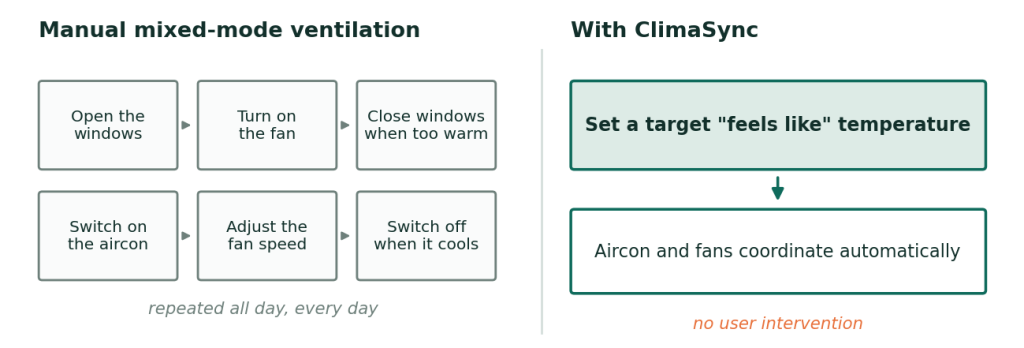
If the savings are this clear, why isn’t MMV everywhere? Because in practice it is tedious. Open the windows, turn on the fan, close the windows when it gets too warm, switch on the aircon, adjust the fan speed, switch off again when it cools. Most people, understandably, default to paying for full-time air-conditioning.
For MMV to move from research finding to mainstream practice, the coordination has to be automated.
ClimaSync: automating the “feels like” temperature
PRISM+ is in a distinctive position as a manufacturer of both air-conditioners and smart ceiling fans. ClimaSync, currently in alpha testing, brings the two together under one app and one control logic, coordinating aircon and fans automatically to hold a target “feels like” temperature rather than a raw thermostat reading.
The system draws on room temperature sensors and humidity measurement built into the air-conditioner, then estimates perceived temperature using airflow models validated through testing. Because thermal comfort varies from person to person, users can fine-tune their preferences in the app.
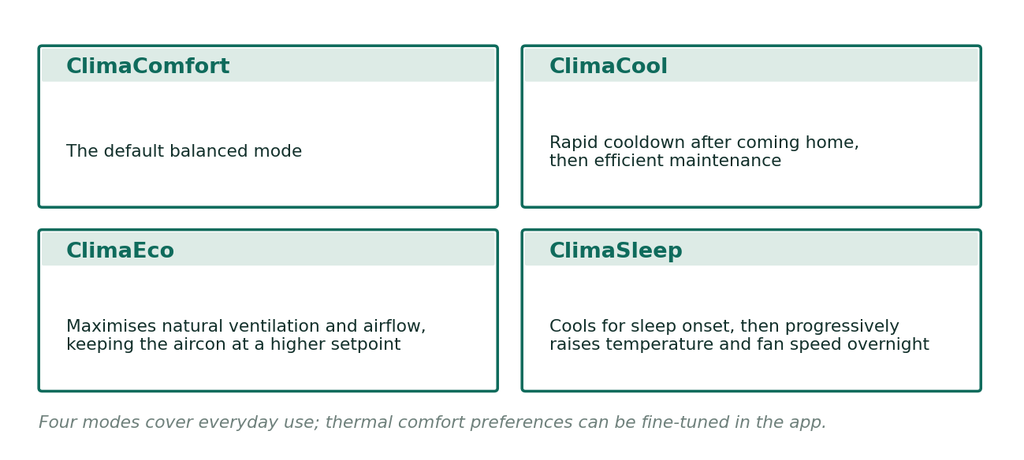
Four modes cover everyday use:
- ClimaComfort: the default balanced mode
- ClimaCool: rapid cooldown after coming home, then efficient maintenance
- ClimaEco: maximises natural ventilation and airflow, keeping the aircon at a higher setpoint
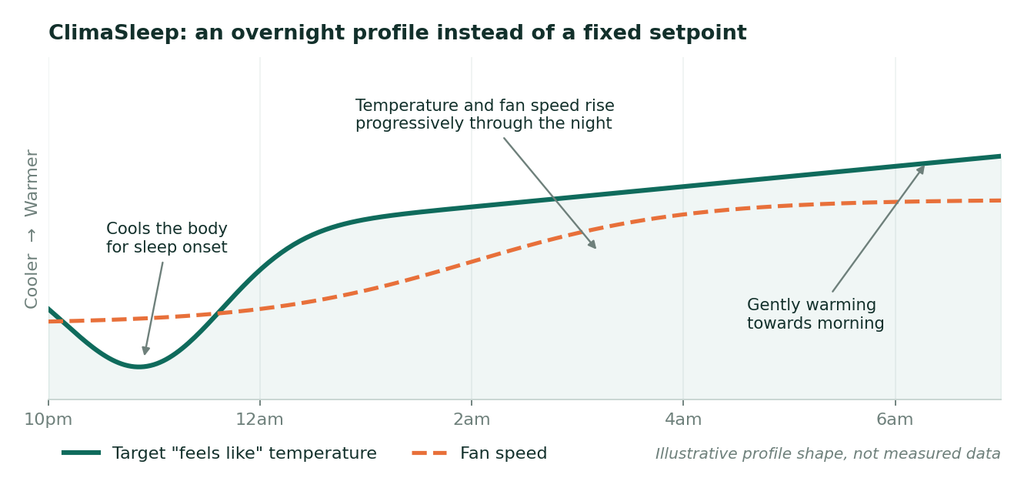
- ClimaSleep: cools the body down for sleep onset, then progressively raises temperature and fan speed through the night, gently warming towards morning. This mode alone is estimated to cut cooling energy by over 30%
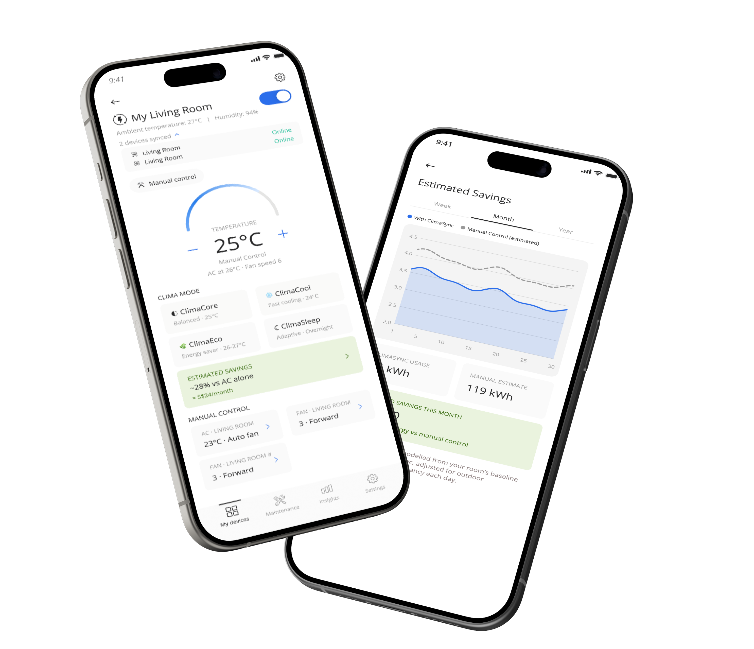
Across the full integrated system, savings of up to nearly half of typical cooling energy are possible versus continuous air-conditioning, with around 30% a realistic expectation for most users.
An invitation to the built environment community
ClimaSync has been developed for homes, but the underlying approach, automated coordination of airflow and air-conditioning around perceived temperature, applies directly to offices, common areas and other commercial spaces where cooling dominates the energy bill.
ClimaSync will be fully launched as a feature in October 2026 on the PRISM+ Connect app, for homeowners and businesses alike. Stay tuned!
For building owners and facility managers pursuing heat resilience and energy targets, the message from the research is encouraging: occupants can be kept comfortable at higher setpoints. The technology to make it effortless is now within reach.
PRISM+ is a Singapore-based consumer electronics and smart home brand. To explore a ClimaSync partnership, contact the PRISM+ team at [email protected].
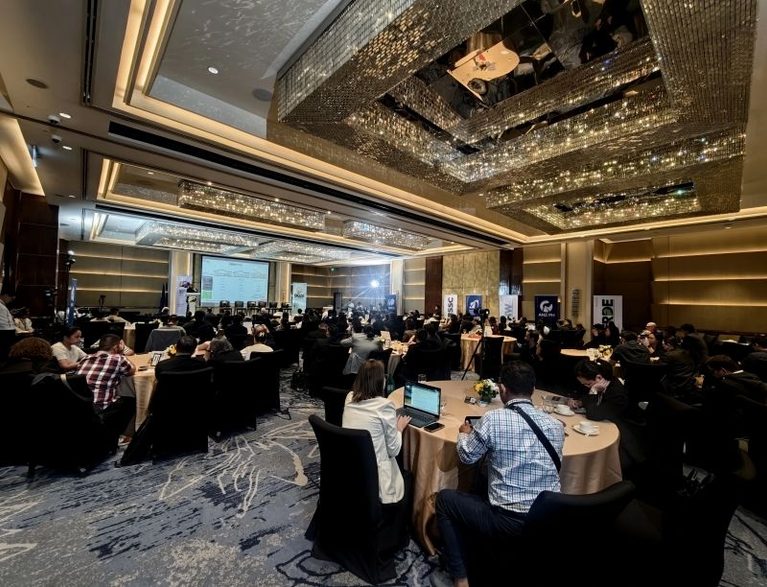
Excerpts from PRISM+ COO Fong Kah Jo’s presentation delivered during the SGBC CPD Seminar @ BEX Asia 2026 on 5 September 2026.